
What is AOD 9604 and How Does It Work?
AOD 9604, short for Anti-Obesity Drug 9604, is a synthetic peptide analogue derived from the C-terminal fragment of human growth hormone (hGH), specifically amino acids 176 to 191. Originally developed by researchers at Monash University in Melbourne, Australia during the 1990s, it was engineered to replicate the fat-metabolising properties of hGH without causing the broad hormonal disruptions that come with full-spectrum growth hormone therapy. At Peptides Lab, we consider it one of the most important compounds in modern peptide science, precisely because of this targeted mechanism of action.
Unlike complete human growth hormone, AOD 9604 does not bind to the growth hormone receptor and does not stimulate the production of insulin-like growth factor 1, commonly known as IGF-1. This distinction is critical. Full-length HGH is a powerful but blunt instrument — it drives growth across multiple systems in the body, which is why prolonged use leads to insulin resistance, joint swelling, and unwanted tissue growth. AOD 9604, by contrast, acts with remarkable specificity, targeting only the biological processes responsible for fat regulation.
The science behind this comes down to which region of the HGH molecule is responsible for what function. Researchers discovered that the C-terminal fragment — the precise segment that AOD 9604 represents — is the portion of HGH that governs lipolysis, the process by which your body breaks down stored fat for energy. This fragment also inhibits lipogenesis, the formation of new fat cells. By isolating and synthesising this region, scientists created a compound that delivers the fat-burning benefit of HGH while bypassing its growth-promoting and insulin-disrupting properties. AOD 9604 achieves this by acting on beta-3 adrenergic receptors found in adipose tissue, triggering fat breakdown through a pathway that completely bypasses the GH receptor [2].
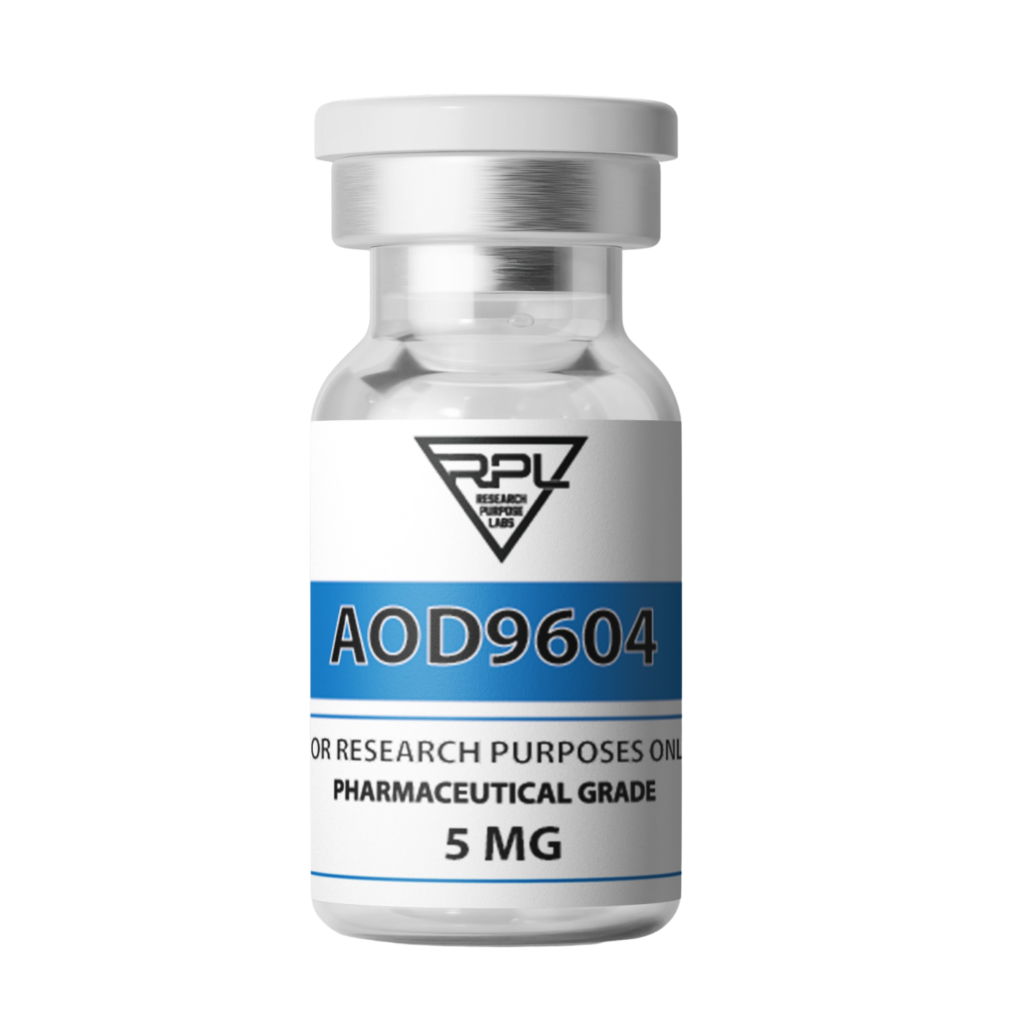
The Science Behind AOD 9604 and Its HGH Connection
To fully appreciate what makes AOD 9604 remarkable, it helps to understand its relationship to human growth hormone. HGH is a 191-amino-acid protein produced by the pituitary gland that regulates growth, cellular repair, metabolism, and body composition across the entire body. For decades, athletes and anti-ageing practitioners have used synthetic HGH to reduce fat and improve physique, but the side effects have always limited its broader application. Elevated IGF-1 levels, carpal tunnel syndrome, insulin resistance, and heightened cancer risk are among the documented concerns associated with long-term HGH use [1].
AOD 9604 emerged from the question: what if we could isolate only the part of HGH that burns fat? After years of research, scientists at Monash University confirmed that the answer was yes. The 176–191 fragment demonstrated the same lipolytic activity as full HGH in animal and human studies, while producing none of the growth-promoting or insulin-disrupting effects. In 2014, the US Food and Drug Administration granted AOD 9604 GRAS status — Generally Recognised As Safe — making it one of the very few peptides to receive this classification. This milestone reflects the depth and quality of the clinical evidence supporting its safety profile [6].
7 Proven Benefits of AOD 9604 You Need to Know
One of the most compelling aspects of AOD 9604 is the breadth of benefits supported by clinical and preclinical evidence. The most well-established benefit is targeted fat loss. Multiple clinical trials, including a 12-week randomised controlled study, demonstrated that subjects receiving AOD 9604 experienced significantly greater reductions in body fat compared to placebo groups, with no corresponding loss of lean muscle mass [4]. This makes it particularly valuable for individuals pursuing body recomposition — the goal of simultaneously reducing fat while preserving or building muscle tissue.
Beyond burning existing fat, AOD 9604 also prevents the creation of new fat cells through its inhibition of lipogenesis. This dual-action property addresses both sides of the fat-gain equation at once, making it more comprehensive than most conventional fat-loss interventions, which typically only accelerate energy expenditure without addressing fat cell proliferation [2].
Emerging research has revealed a third area of benefit that surprised many in the scientific community: joint and cartilage repair. A series of preclinical and early-phase clinical studies found that AOD 9604 promotes the regeneration of damaged cartilage tissue. While this research is still developing, it has made the peptide of significant interest to athletes recovering from joint injuries and to those managing early-stage osteoarthritis [5]. This adds a meaningful recovery dimension to what was originally conceived purely as a metabolic compound.
AOD 9604 has also been shown to improve lipid profiles in some subjects, with reductions in total cholesterol and improvements in the ratio of high-density lipoprotein to low-density lipoprotein observed in clinical settings [1]. Combined with its demonstrated absence of effect on blood glucose or insulin levels — a critical contrast to HGH therapy — this creates a safety and metabolic profile that is genuinely difficult to match among other fat-loss compounds. The fact that it does not influence IGF-1 further reduces the long-term risk profile, given that chronically elevated IGF-1 has been linked in some studies to increased cancer risk and accelerated cellular ageing [3].
How to Use AOD 9604 for Maximum Fat Loss: Dosage, Cycle Length, and Stacking Tips
Based on the available clinical research and current practitioner protocols, the most widely used and well-tolerated dosage of AOD 9604 falls between 250 and 300 micrograms per day for general use, with some clinical protocols extending to 500 to 1,000 micrograms daily under direct medical supervision. The peptide is typically administered once per day, most commonly in the morning on an empty stomach or 30 to 60 minutes before the first meal or training session. This timing takes advantage of the fasted metabolic state and appears to enhance the lipolytic response. A standard cycle runs for 12 weeks, followed by a rest period of four to six weeks before resuming.
AOD 9604 is administered via subcutaneous injection — a relatively shallow injection just beneath the skin, typically in the lower abdominal area. First-time users should use a 29 to 31 gauge insulin syringe for precision, rotate injection sites daily to avoid localised irritation, and store the reconstituted peptide refrigerated at 2 to 8 degrees Celsius, using it within 30 days of reconstitution. At Peptides Lab, we always emphasise that these dosing parameters are based on research literature and should be treated as a starting point for discussion with a qualified healthcare professional, not as a substitute for medical advice.
When it comes to stacking, AOD 9604 combines particularly well with several other peptides for synergistic effects. Pairing it with CJC-1295 and Ipamorelin — a combination that enhances growth hormone pulsing — allows AOD 9604 to handle the specific fat-metabolism component while the GHRH and GHRP peptides optimise the broader hormonal environment for body recomposition. Athletes dealing with inflammation or soft-tissue injuries often stack it with BPC-157 to combine fat loss with powerful recovery properties. For individuals specifically targeting visceral abdominal fat, a combination with Tesamorelin has shown particularly strong clinical support [5].
AOD 9604 vs HGH vs Semaglutide: Which is the Best Fat Loss Option?
With so many fat-loss agents on the market — from full HGH therapy to GLP-1 receptor agonists like semaglutide, sold under the brand names Ozempic and Wegovy — it is worth understanding exactly where AOD 9604 fits in the landscape. Each of these compounds works through a different mechanism and carries a different risk-benefit profile, making the right choice highly individual.
Full HGH therapy is effective for fat loss and muscle preservation, but it comes with significant drawbacks. It raises IGF-1 levels, can cause insulin resistance and fluid retention, requires a prescription in virtually every country, and is expensive. Semaglutide, on the other hand, achieves impressive weight loss results by mimicking the GLP-1 hormone to suppress appetite and slow gastric emptying. It is highly effective for overall weight loss, but it does not specifically target fat while preserving muscle — indeed, a significant proportion of weight lost on GLP-1 agonists can be lean mass, which is a meaningful concern for body composition-focused users. It also requires a prescription, is costly, and carries gastrointestinal side effects that many users find difficult to tolerate.
AOD 9604 occupies a distinct niche. It is specifically targeted at fat tissue, preserves lean muscle, does not affect insulin or IGF-1, carries FDA GRAS status, and has a favourable tolerability profile across multiple human trials. Its cost is moderate compared to both HGH and semaglutide. For individuals whose primary goal is improving body composition — reducing fat while maintaining or building muscle — rather than simply reducing body weight, AOD 9604 presents a uniquely compelling case [3][4].
Potential Side Effects and Safety Considerations
AOD 9604 has demonstrated a strong safety profile across human clinical trials, which forms the basis of its FDA GRAS designation. The most commonly reported side effects are mild and transient, including localised redness or minor irritation at the injection site, brief fatigue following administration, and occasional mild nausea, particularly during the first few days of a new cycle. These effects typically resolve quickly as the body adapts to the compound.
Less commonly, some users report mild headache, temporary water retention, or brief dizziness, particularly if the peptide is administered too quickly or at higher doses without gradual titration. Serious adverse events are rare in the clinical literature, but any allergic reaction, severe injection site pain, or unexpected hormonal symptoms should prompt immediate discontinuation and consultation with a healthcare provider. It is also worth noting that, as with all peptide compounds, the quality and purity of the source material is a significant variable. At Peptides Lab, every product undergoes third-party purity testing precisely because impurities in poorly manufactured peptides are a primary driver of adverse reactions [6].
Frequently Asked Questions About AOD 9604
Many people come to Peptides Lab wondering how long it takes before AOD 9604 produces noticeable results. Based on clinical data and user-reported outcomes, most individuals begin to observe meaningful changes in body composition between four and eight weeks into a consistent daily protocol. Optimal results are generally achieved after completing a full 12-week cycle in conjunction with a calorie-controlled diet and regular exercise. The peptide amplifies and accelerates fat loss, but it works most effectively when the foundational habits are already in place.
A frequent concern relates to the impact of AOD 9604 on blood sugar levels, particularly among individuals who are diabetic or pre-diabetic. The clinical evidence is reassuring on this point: multiple Phase I and Phase II trials confirmed that AOD 9604 does not interfere with insulin signalling or glucose metabolism, setting it clearly apart from full HGH therapy in this respect [3]. People also frequently ask whether AOD 9604 requires a prescription. The answer depends on jurisdiction — in many countries it is available for research purposes without a prescription, while in Australia it is classified as a compounded prescription medication. Peptides Lab strongly encourages all users to verify the regulatory status in their specific country before purchasing.
On the question of legality in sport, AOD 9604 has been listed on the World Anti-Doping Agency prohibited substances list since 2012, meaning competitive athletes subject to WADA testing should not use it [7]. For recreational users and non-competing individuals, this restriction does not apply, but it is important information for anyone in organised sport.
Final Thoughts from Peptides Lab
AOD 9604 represents one of the most scientifically grounded and carefully studied options available to anyone seeking targeted fat loss without the broad hormonal risks associated with full HGH therapy. Its dual action — simultaneously driving lipolysis and inhibiting lipogenesis — its preservation of lean muscle, its neutral effect on insulin and IGF-1, and its FDA GRAS designation collectively make it a standout compound in the peptide landscape. The emerging evidence around joint and cartilage repair only adds to its appeal for active individuals.
Whether you are beginning your journey with peptide therapy or looking to refine an existing protocol, AOD 9604 deserves serious consideration as part of a comprehensive approach to body composition and metabolic health. At Peptides Lab, we provide only the highest purity, third-party tested peptides, paired with the transparent scientific information you need to make informed decisions. As always, we encourage every customer to work with a qualified healthcare provider to design a protocol that is right for their individual physiology, health history, and goals.