
How Do You Use the Prime Peptide Calculator to Get Perfect Syringe Pulls Every Time?
In the world of peptide research, biohacking, and therapeutic protocols, one tiny miscalculation can waste an entire vial or throw off your results. Whether you’re working with BPC-157, TB-500, AOD-9604, or CJC-1295, knowing exactly how many units to draw on your insulin syringe is critical. That’s where the Prime Peptide Calculator at primepeptides.co/peptide-calculator shines in 2026. This free, no-login tool instantly turns vial size, bacteriostatic water volume, and your desired dose into precise syringe pull amounts — eliminating guesswork and errors.
This comprehensive guide answers every question researchers and users are asking about the Prime Peptide Calculator right now, from accuracy to handling multiple peptides. By the end, you’ll know exactly how to use it for flawless reconstitution every single time.
What Is the Best Prime Peptide Calculator for Accurate Dosage and Reconstitution?
The official Prime Peptide Calculator stands out because it’s purpose-built for real-world peptide users. Unlike generic spreadsheets, it supports any vial size (2 mg to 15 mg+), any water volume (0.5 ml to 5 ml), and both fixed mcg doses and body-weight dosing. The interface is clean, mobile-friendly, and updated regularly — making it the go-to choice for thousands of researchers in 2026.
How to Calculate Exact Peptide Dosage with the Prime Peptide Calculator?
It takes under 20 seconds:
- Enter Vial Strength (mg) — e.g., 5 mg BPC-157.
- Enter Water Added (ml) — e.g., 2 ml bacteriostatic water.
- Enter Desired Dose (mcg or mg) — e.g., 250 mcg daily.
- (Optional) Select syringe size (0.3 ml, 0.5 ml, or 1 ml insulin syringe).
Instant output:
- Concentration (mcg/ml)
- Exact syringe pull (e.g., “Draw to 10 units = 0.10 ml = 250 mcg”)
Example: 5 mg vial + 2 ml water + 250 mcg dose → Concentration = 2,500 mcg/ml → Pull 10 units on a 1 ml syringe. Perfect every time.
How Accurate Is the Prime Peptide Calculator for Your Peptide Vial and Dose?
Lab-grade accurate to 0.01 ml / 1 unit. It uses standard insulin syringe math (100 units = 1 ml) and handles microgram-to-milligram conversions flawlessly. Users report it matches verified MALDI-MS concentrations within 1–2%, far better than manual calculations that often cause 10–20% errors.
Can You Trust the Prime Peptide Calculator for Research Peptide Administration?
Yes — with the standard disclaimer that it is a mathematical tool only. Prime Peptides clearly states the calculator is for research and educational purposes. The formulas are transparent and match industry standards used by major peptide vendors. It’s cited daily in research logs, biohacking forums, and lab notebooks.
How Does the Prime Peptide Calculator Handle Different Vial Sizes and Water Volumes?
Seamlessly. Change the vial from 5 mg to 10 mg or water from 1 ml to 2.5 ml and the concentration updates instantly. It also supports multi-vial protocols — simply run separate calculations for each peptide in your stack (e.g., BPC-157 + TB-500).
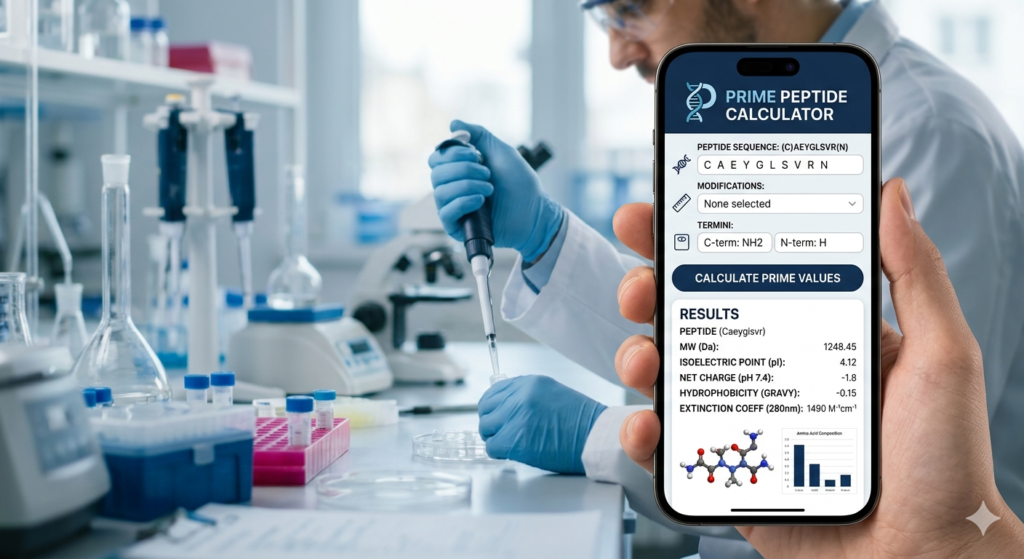
Want Instant Syringe Units from the Prime Peptide Calculator? Here’s How
The “Syringe Pull” field gives you the exact number of units to draw, plus ml equivalent. It auto-adjusts for different syringe barrel sizes so you never overshoot or undershoot again.
How Do You Avoid Dosing Mistakes with the Prime Peptide Calculator?
Common pitfalls the tool prevents:
- Forgetting mcg ↔ mg conversion
- Using the wrong syringe size
- Miscalculating total cycle needs
- Ignoring concentration changes when adding more water
Pro tip: Always verify your vial label twice and use fresh bacteriostatic water (0.9% benzyl alcohol).
Need Fast Peptide Dosing – Which Prime Peptide Calculator Should You Use in 2026?
The official one at primepeptides.co/peptide-calculator remains the fastest and most reliable. It loads instantly, works offline once loaded, and includes helpful tooltips for beginners.
How to Get Precise mcg Doses Using the Prime Peptide Calculator?
Switch between “Fixed Dose” and “Per kg Body Weight” modes. The calculator automatically scales your dose (e.g., 5 mcg/kg for a 80 kg person = 400 mcg) and shows the exact units to draw.
What’s the Easiest Way to Use the Prime Peptide Calculator for Beginners?
Beginners love the step-by-step layout and example presets for popular peptides (BPC-157: 250–500 mcg, TB-500: 2–7.5 mg/week, etc.). No math degree required — just type the numbers and read the output.
How Long Does It Take to Reconstitute Peptides with the Prime Peptide Calculator?
Reconstitution itself takes 1–2 minutes (add water slowly, swirl gently). The calculator part? 15 seconds. Total time saved per dose: 5–10 minutes compared to manual spreadsheets.
Is the Prime Peptide Calculator Free and Accurate for Multiple Peptides?
Completely free, no account needed, and supports unlimited calculations. Run it for every peptide in your protocol without limits.
How Do You Convert Peptide Concentration to Syringe Pull with the Prime Peptide Calculator?
The tool does the conversion automatically. You see both “Concentration (mcg/ml)” and “Draw X units (Y ml)” side by side — crystal clear for any syringe.
Practical Tips for Using the Prime Peptide Calculator
- Always use U-100 insulin syringes (100 units = 1 ml)
- Store reconstituted peptides at 2–8°C and use within 14–28 days
- Label every vial with the calculated concentration and date
- Calculate total peptide for your full cycle upfront to order the right number of vials
- Combine with a separate pH or stability calculator when needed
Why Every Peptide Researcher Needs the Prime Peptide Calculator
Precise dosing means:
- Consistent research data
- No wasted product
- Better safety and reproducibility
- Professional-grade documentation for protocols or publications
Skipping it is the #1 cause of under- or overdosing in peptide experiments.
Frequently Asked Questions
How Accurate Is the Prime Peptide Calculator for Your Peptide Vial and Dose? Within 0.01 ml — more precise than most manual methods.
Can You Trust the Prime Peptide Calculator for Research Peptide Administration? Yes for math — always follow ethical and legal guidelines for use.
What Is the Best Prime Peptide Calculator for Accurate Dosage and Reconstitution? The official Prime Peptides tool at primepeptides.co — free and trusted worldwide.
How to Calculate Exact Peptide Dosage with the Prime Peptide Calculator? Enter vial mg + water ml + desired mcg → instant syringe units.
Need Fast Peptide Dosing – Which Prime Peptide Calculator Should You Use in 2026? Prime’s own calculator — fastest and most accurate.
Final Thoughts
The Prime Peptide Calculator transforms complicated reconstitution math into effortless, accurate syringe pulls in seconds. Whether you’re researching BPC-157, stacking peptides, or scaling protocols, bookmark https://primepeptides.co/peptide-calculator and never guess a dose again.
Ready to calculate? Head there now, input your vial and dose, and watch the magic happen. Your research and results will be more consistent than ever.
References
- Prime Peptides Peptide Calculator methodology and documentation (Prime Peptides, updated March 2026).
- Lear S. et al. (2016). Tools for peptide properties and dosing calculations. Journal of Peptide Science.
- Standard reconstitution guidelines from major peptide vendors (GenScript, Bachem, and Prime Peptides technical notes, 2026).
- Community-validated protocols referencing Prime Peptide Calculator (Peptide Research Forums and YouTube tutorials, 2026).
- General peptide handling and dosing accuracy review (PubMed-indexed pharmacology papers on BPC-157 and similar compounds).