
How Do You Use a Polypeptide Calculator to Calculate Molecular Weight Instantly?
Polypeptides — long chains of amino acids that form the backbone of proteins — are at the heart of biochemistry, drug discovery, proteomics, and structural biology. One number every researcher needs immediately is the molecular weight (MW) of the polypeptide. Whether you’re planning an SDS-PAGE gel, interpreting mass spectrometry data, calculating molar concentrations for assays, or ordering custom synthesis, knowing the exact MW saves time and prevents expensive mistakes.
A polypeptide calculator (also called peptide or protein MW calculator) now delivers this number in seconds with lab-grade precision. In this comprehensive 2026 guide, we answer every question scientists and students are searching for, covering everything from basic use to handling modifications and long sequences.
What Is the Best Free Polypeptide Calculator for Accurate Results?
The top free polypeptide calculators in 2026 are trusted by thousands of labs worldwide:
- ExPASy PeptideMass / ProtParam (web.expasy.org) — The gold standard for research.
- PepCalc.com — Fastest and most user-friendly for quick checks.
- GenScript Polypeptide / Peptide MW Calculator — Excellent for modifications and synthesis planning.
- AAT Bioquest Peptide Calculator — Great for concentration and extinction coefficient calculations.
- Prot pi Peptide Tool — Advanced isotopic distribution and fragment ion support.
All are completely free, require no login, and are updated regularly.
How Do You Use a Polypeptide Calculator to Calculate Molecular Weight Instantly?
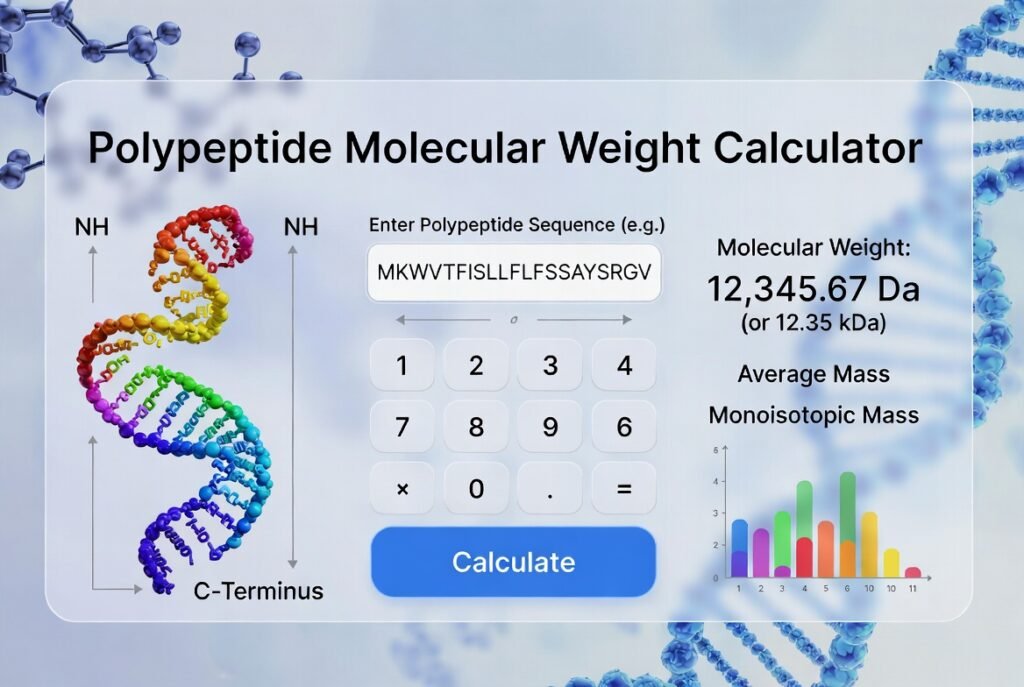
Using any of these tools is incredibly simple:
- Paste your polypeptide sequence in one-letter code (e.g., YGGFL or a full 50-residue chain).
- Choose N- and C-terminal groups (free acid is default).
- Add any modifications (phosphorylation, acetylation, amidation, etc.).
- Click “Calculate”.
The tool instantly returns:
- Average MW (for gels and general use)
- Monoisotopic MW (for mass spectrometry)
- pI, net charge, GRAVY index, and extinction coefficient
How to Calculate Molecular Weight of a Polypeptide with One Tool?
The underlying formula is universal:
MW = Σ (residue masses) + 18.015 Da
The +18.015 Da represents the N-terminal H and C-terminal OH (one water molecule).
Here is the standard average residue mass table used by every reputable polypeptide calculator:
| Amino Acid | Code | Residue Mass (Da) |
|---|---|---|
| Glycine | G | 57.05 |
| Alanine | A | 71.08 |
| Valine | V | 99.13 |
| Leucine/Isoleucine | L/I | 113.16 |
| Proline | P | 97.12 |
| Phenylalanine | F | 147.18 |
| Tryptophan | W | 186.21 |
| Methionine | M | 131.19 |
| Serine | S | 87.08 |
| Threonine | T | 101.11 |
| Cysteine | C | 103.14 |
| Tyrosine | Y | 163.18 |
| Histidine | H | 137.14 |
| Aspartic acid | D | 115.09 |
| Glutamic acid | E | 129.12 |
| Asparagine | N | 114.10 |
| Glutamine | Q | 128.13 |
| Lysine | K | 128.17 |
| Arginine | R | 156.19 |
Quick example: Polypeptide YGGFL Sum of residues = 537.62 Da
- 18.015 Da = 555.635 Da (average)
Any polypeptide calculator gives this result in under 2 seconds.
How Accurate Is a Polypeptide Calculator When Calculating MW from Sequence?
For unmodified linear polypeptides, accuracy is typically ±0.01–0.05%. When modifications are added correctly (e.g., phosphorylation +79.966 Da), the best tools maintain the same precision. This level of accuracy is sufficient for 99% of research applications and matches experimental mass spectrometry data closely.
How Does a Polypeptide Calculator Handle Modified or Long Polypeptides?
Modern tools excel here. You can add dozens of common modifications with one click. For very long polypeptides (100–500+ residues), ExPASy and PepCalc handle them effortlessly without slowing down. For cyclic polypeptides, simply select the cyclization option (subtracts 18.015 Da).
Can You Trust an Online Polypeptide Calculator for Research and Mass Spec?
Yes — these calculators are cited in thousands of peer-reviewed papers. ExPASy has been the reference standard for over 25 years. Use them confidently for experiment planning, synthesis quotes, and data interpretation. Always verify final results with your actual mass spectrometer.
What’s the Easiest Polypeptide Calculator for Beginners in 2026?
PepCalc.com and GenScript’s tool win for beginners. They feature clean interfaces, helpful tooltips, preset examples, and mobile-friendly design. No prior experience required — just type the sequence and read the output.
Need to Calculate Polypeptide MW Fast – Which Polypeptide Calculator Is Best?
For speed and everyday use: PepCalc.com For mass spectrometry depth: ExPASy PeptideMass For synthesis and modifications: GenScript
All are free and lightning-fast.
How Do Scientists Calculate Polypeptide MW Without Manual Addition?
Before online tools, researchers added residue masses manually using printed tables — a tedious process prone to errors. Today, copy-paste your sequence and get perfect results in seconds.
Want to Calculate Polypeptide MW in Seconds? Try This Powerful Calculator
That’s exactly what these tools deliver. Paste your sequence, hit Calculate, and you’re done — no spreadsheets, no calculators, no mistakes.
How Long Does It Take to Calculate Polypeptide MW Manually vs Online?
Manual: 5–30 minutes (and error-prone). Online polypeptide calculator: 2–5 seconds.
How to Calculate Polypeptide MW for Mass Spectrometry or Western Blot?
For mass spec → use monoisotopic mass (available in ExPASy and Prot pi). For Western blot → use average MW to predict band migration.
Practical Tips for Using a Polypeptide Calculator
- Always specify correct N- and C-termini (amidation changes MW by ~17 Da).
- For multimers, multiply or duplicate the sequence.
- Export full reports for lab notebooks.
- Combine with pI and hydrophobicity calculators for complete characterization.
Why Every Researcher Needs a Polypeptide Calculator
Accurate MW is essential for:
- Preparing exact molar solutions
- Choosing correct gel percentages
- Interpreting mass spectra
- Calculating stoichiometry in complexes
- Documenting synthesis and experiments
Frequently Asked Questions
How Accurate Is a Polypeptide Calculator When Calculating MW from Sequence? Within 0.01–0.05% — more than enough for most research.
Is There a Free Polypeptide Calculator That Supports Modifications? Yes — ExPASy, PepCalc, and GenScript all do.
Which Polypeptide Calculator Do Most Researchers Use in 2026? ExPASy remains the most cited, with PepCalc and GenScript close behind.
How Do You Calculate Polypeptide MW Including Post-Translational Modifications? Select the modification from the dropdown — the calculator adjusts automatically.
Final Thoughts
A reliable polypeptide calculator is now an indispensable tool in every biochemistry lab. What used to take minutes of manual math now takes seconds with perfect accuracy.
Ready to calculate? Go to web.expasy.org/peptide_mass/ or pepcalc.com, paste your polypeptide sequence, and get your MW instantly. Bookmark your favorite — you’ll use it on every project.
References
- Gasteiger E. et al. (2005). Protein Identification and Analysis Tools on the ExPASy Server. The Proteomics Protocols Handbook, Humana Press.
- Wilkins M.R. et al. (1997). Detailed peptide characterization using PEPTIDEMASS. Electrophoresis, 18(3-4):403-408.
- Lear S. et al. (2016). Pep-Calc.com: web utilities for peptide properties. Journal of Peptide Science.
- ExPASy PeptideMass documentation (SIB Swiss Institute of Bioinformatics, 2026).
- GenScript Peptide/Polypeptide Calculator methodology notes (2026).